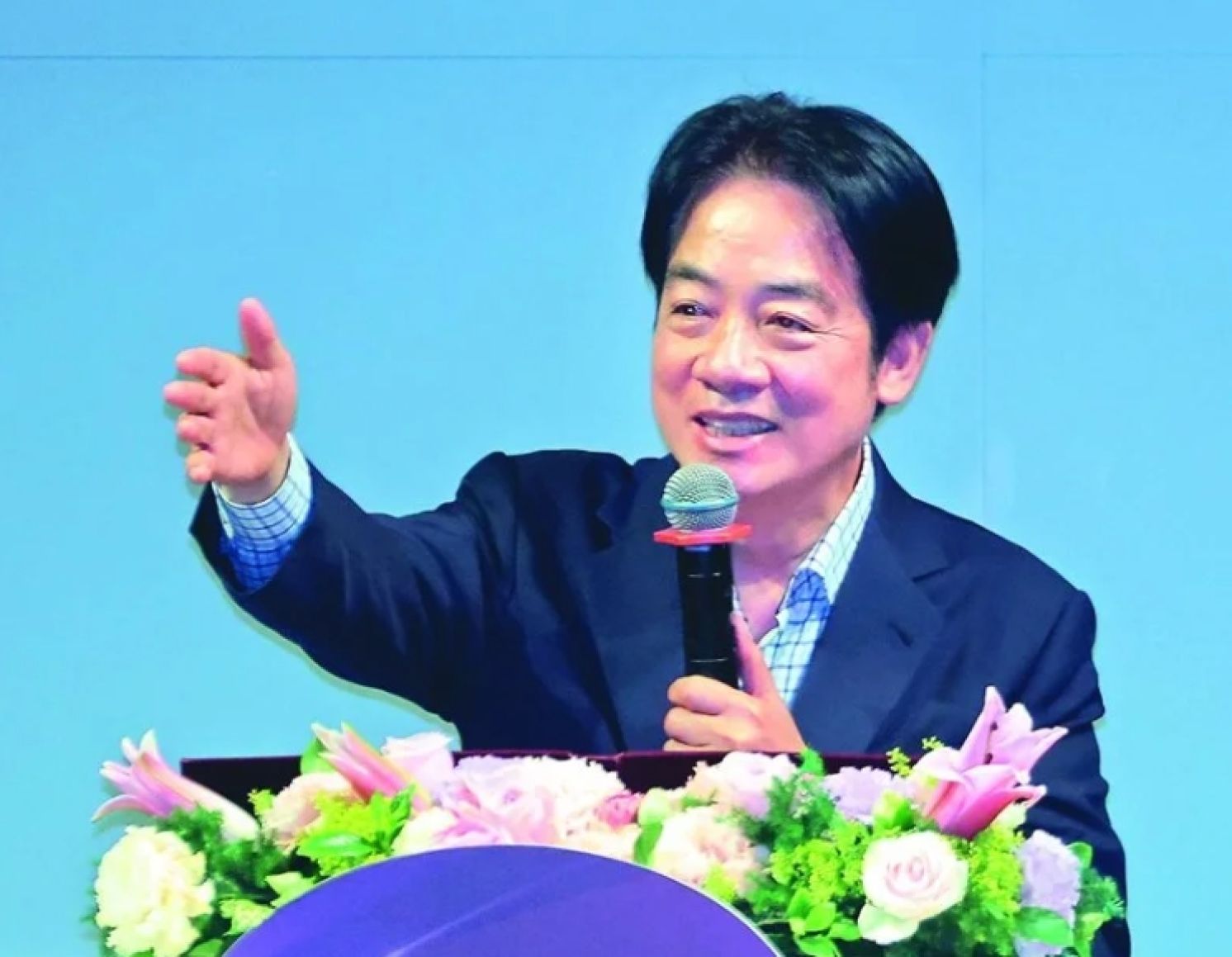
President Lai's Double Betrayal: From Anti to Pro-Nuclear
United Daily News Commentary, March 23, 2026
President Lai Ching-te suddenly announced preparations to restart Nuclear Power Plants Nos. 2 and 3, triggering an uproar within the ruling Democratic Progressive Party (DPP). Civic groups friendly to the DPP administration, long tasked with defending policy, were pushed to the brink and threatened to expand street protests. Supporters are dissatisfied with the president’s all-encompassing justifications, questioning why there was no communication with public opinion, likening it to a sneak attack and a betrayal. In fact, the Lai administration had already signed “tied procurement” clauses in the U.S.–Taiwan Agreement on Reciprocal Trade (ART), pledging “not to purchase any nuclear reactors, fuel rods, or enriched uranium from countries that raise national security concerns.” Without a plan to “return to nuclear power,” why would Taiwan—having reduced nuclear energy to zero—make such a commitment?
Section 5 of the ART, “Economy and National Security,” establishes national security thresholds for sensitive U.S.–Taiwan investment, trade, and procurement. In addition to requiring annual defense budgets to exceed 3 percent of gross domestic product (GDP), another largely unnoticed provision is Section 5.4.7, which restricts Taiwan’s nuclear energy procurement targets—in plain terms, “procurement may only be made from vendors approved by the United States.” Former President Tsai Ing-wen had already sent the Nuclear Power Plant No. 4 fuel rods back to the United States, and Nuclear Power Plant No. 3 was decommissioned in May last year, bringing nuclear energy to zero. At the same time, Taiwan and the United States launched tariff negotiations and signed nuclear procurement regulations within the ART. Can Vice Premier Cheng Li-chun explain what is going on?
Ironically, at the same time, the opposition Kuomintang (KMT) and Taiwan People’s Party (TPP) have been pushing amendments to the Nuclear Reactor Facilities Regulation Act to extend the operation of aging nuclear power plants. DPP Legislator Fan Yun strongly criticized the amendments as anti-social justice, anti-democratic, anti-national security, and anti-intellectual, even smearing them as “opening the back door for Communist China.” The content of the ART proves that Vice Premier Cheng, who went to the United States for negotiations under presidential orders, is in fact the driving force “preparing to open the back door for Communist China.”
President Lai used opposition to the “referendum on restarting Nuclear Three” to build momentum for a mass recall campaign and consolidate power, while privately instructing the negotiation team to discuss a “return to nuclear power” with the United States. This is not only a reversal against anti-nuclear advocates, but also a betrayal of the entire country.
The DPP has paid an enormous price in pursuing a “nuclear-free homeland,” from social divisions to economic and livelihood impacts—fractures and sacrifices that are difficult to repair. Even if the United States requires Taiwan to ensure semiconductor supply chain security and to use nuclear power for stable electricity supply, the government should openly communicate with society and explain that “circumstances necessitate it.” Instead, President Lai learned from U.S. President Donald Trump’s tactic of “surprise attacks,” treating the public as if they were enemies.
DPP Legislator Wu Szu-yao has tried to shape the narrative by saying that “the nuclear power issue is only just beginning, and the most urgent matter is arms procurement,” while some affiliated voices claim that a “return to nuclear power” is a precaution against China. The Lai administration has consistently handled matters concerning public safety and welfare in a “top-down directive” manner, using anti-China reasoning to justify opaque decision-making. This time, the “return to nuclear power” is clearly driven by U.S. supply chain security priorities, effectively toppling its own core principles. If it then uses anti-China arguments or the opposition-controlled legislature’s amendments as an excuse, would that not prove that Lai Ching-te cannot withstand “external forces,” and is even incapable of defending his own core principles?
Energy security and resilience are a shared national consensus and should not be highly divisive. Yet President Lai has fully accepted American pressure without allowing public participation, depriving society of the space to discuss a reasonable balance between nuclear and green energy, while also planting the seeds of conflict for restarting nuclear power and once again tearing society apart.
In the past, the “nuclear-free homeland” helped the DPP win power, but now it is dismantling its own core principle in exchange for political support. Ironically, social activists invoke the memory of former DPP Chairman Lin Yi-hsiung, who waged fasting campaigns to protest nuclear power. But can that determination stand up to U.S. demands for Taiwan to ensure supply chain security? If the people cannot decide for the country, then even an elected puppet president is a tragedy for Taiwan.